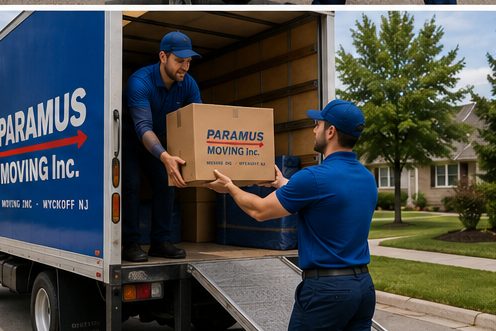
Every sealed brown box looks exactly like every other sealed brown box. That’s the entire problem of moving in one sentence. The word “MISC” scrawled on a lid is where belongings go to disappear for six months. A real labeling system costs seconds per box and pays off three times: when the crew loads, when they unload, and every single time you look for something in the weeks after. Here’s the version that works.
The three-line label: room, contents, priority
Every box gets three lines in thick, dark marker. Line one: the destination room in the new house—not where the stuff came from. If the old office is becoming the nursery, boxes packed there should say NURSERY, because labels are instructions for the future, not records of the past.
Line two: real contents. Not “kitchen”—the box is already labeled kitchen. Write what’s inside: “pots and lids,” “everyday plates,” “junk drawer + phone chargers.” Specific enough that three weeks from now you can find the thing without opening five boxes.
Line three: priority. Four levels cover it: OPEN FIRST, FIRST WEEK, WHENEVER, and STORAGE. Now the first evening has a to-do list built into the box stacks, and the storage boxes go straight to the basement instead of clogging a bedroom.
Label the sides, not the top
The most common labeling mistake is writing everything on the lid. The moment boxes are stacked—which is their permanent condition from loading until unpacking—every lid is hidden under another box. Label at least two sides, ideally opposite sides, so a label faces you no matter how the stack is turned.
While the marker is out: boxes with breakables get FRAGILE and THIS END UP on all four sides with arrows, and anything unusually heavy gets a HEAVY flag so nobody gets surprised at the bottom of a staircase. If you’re reusing old boxes, cross out the previous labels completely—a box that says both KITCHEN and ATTIC is a coin flip.
Numbers and a master list
This is the step that separates a decent system from a great one, and it costs almost nothing. Number every box as you seal it and keep a running list—a notebook or a note on your phone: #23, kitchen, pots and lids. #24, office, tax files.
The payoff comes twice. At delivery, you can count boxes against the list and know immediately whether everything arrived—not weeks later when something turns up missing. And if a box is lost or something arrives damaged, a numbered inventory is exactly the documentation a claim needs; our post on how moving damage claims work explains why the paper trail matters so much. Photographing the open box before sealing the flaps takes one more second and makes the record even stronger.
Color tape turns the crew loose
Here’s the professional touch: assign each room a color of tape—blue for kitchen, green for the primary bedroom, red for the office—and run a stripe of it on every box for that room. Then, at the new house, tape a matching swatch on each room’s door frame.
Now nobody has to read anything or ask anything. A crew member with a blue-striped box walks it to the blue door, every trip, no questions. On a local move billed by time, a crew that never stops to ask “where does this go?” is quietly saving you money all day—our local moving page explains how the hourly clock works. Color-coding is also a perfect job for kids who want to help: hand them the tape rolls and a chart.
One warning from experience: don’t invent a system so clever it needs a decoder ring. Elaborate abbreviation schemes and tiny handwriting defeat the purpose, because the crew—and your future self—should understand every label at a glance from six feet away. Big letters, plain words, consistent colors. Boring is the goal.
None of this takes real time—it’s ten minutes of marker work spread across the days you were packing anyway. If even that sounds like too much, our packing crews label as they go; it’s part of the job. Either way, boxes that announce where they belong make moving day shorter, and shorter is better for everyone—starting with your free written estimate, which will reflect a move that’s organized before it starts.
Moving in Bergen County? Free written estimate — in person or by video.
Get my free estimate Call (201) 652-5554