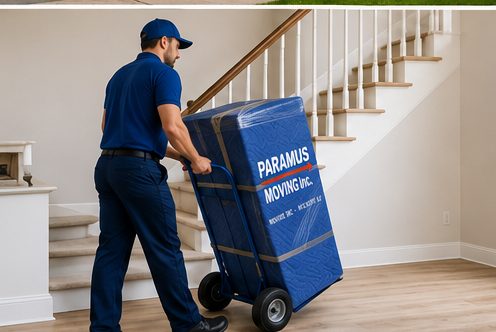
Almost everyone underestimates. The packing starts confidently, the box pile shrinks faster than the house does, and by the third emergency run for more boxes the whole schedule is wobbling. There’s a better way: estimate room by room, sanity-check against your home size, and build in a cushion from the start.
Know your box sizes first
Box math only works if you know what the sizes mean. A small box (about 1.5 cubic feet, roughly 16x12x12 inches) is for dense weight: books, tools, canned goods, files. A medium box (about 3 cubic feet) is the all-purpose workhorse—most of an average house goes in mediums. A large box (about 4.5 cubic feet) is for light and bulky things: bedding, pillows, lampshades, plastic bins’ worth of toys. Extra-large boxes exist, but they’re easy to overload and hard to carry, so buy them sparingly.
Two specialty boxes earn their keep in almost every move: dish packs, double-walled cartons for the kitchen’s breakables, and wardrobe boxes, tall cartons with a hanger bar that swallow a couple of feet of closet rod each.
Estimate room by room
Walk the house with a notepad and use these working ranges. A kitchen runs fifteen to twenty boxes, including three to five dish packs—kitchens always pack bigger than they look. Each bedroom takes ten to fifteen boxes plus two or three wardrobe boxes. A living room is ten to fifteen, a dining room five to ten (more with a china cabinet), a bathroom three to five, and a home office eight to twelve, heavy on small boxes for books and files.
Then there’s the wild card: garage, basement, and attic. Depending on how long you’ve lived there, that’s anywhere from ten boxes to thirty-plus, and it’s the area people most consistently forget to count. Open every closet and cabinet while you’re estimating—closed doors are where box counts go to die.
Sanity-check by home size
Your room-by-room total should land somewhere near these overall ranges: a studio, twenty to forty boxes; a one-bedroom, thirty-five to fifty; a two-bedroom, sixty to eighty; a three-bedroom, eighty to one hundred twenty; a four-bedroom or larger, one hundred twenty and up.
The ranges are wide because homes vary wildly in what you might call stuff density. Ten years in the same house, kids, hobbies with equipment, a finished basement—each one pushes you toward the top of the range. If you’ve recently decluttered, you’ll trend toward the bottom. If your room-by-room count lands far outside the range for your home size, recount before you shop—usually it means a forgotten attic or a garage you were quietly hoping would pack itself.
Buy more than you think, and buy smart
Whatever number you land on, add a dozen boxes on top. The last stretch of packing always uncovers more than anyone expects, and unused boxes are a far smaller problem than a midnight shortage—most suppliers take back unbuilt boxes, and flattened ones store easily. Skimp on boxes and people start improvising with garbage bags, which is how things get crushed and lost.
Free used boxes from grocery stores can work for sturdy, non-fragile loads, but the sizes are inconsistent (which makes trucks load badly) and a box that’s already made three trips has lost much of its strength. Buy new for anything breakable.
Don’t forget the supplies that go with the boxes. Plan on roughly one roll of packing tape per fifteen to twenty boxes, a good tape gun (it genuinely doubles your speed), thick markers in a couple of colors, and packing paper—lots of it. A kitchen alone can eat ten pounds of paper, and a whole house several times that. Paper is the item people most underestimate, and running out of it is how towels end up wrapped around the good glasses at the last minute. Boxes and paper are also a real line in the moving budget, which we cover honestly in what a move costs in New Jersey.
And if you’d rather not guess at all: when we do a free written estimate, sizing up the box count is part of the walkthrough—it’s the same survey that sizes the truck and the crew. Pair it with our moving checklist and the box pile stops being a mystery.
Moving in Bergen County? Free written estimate — in person or by video.
Get my free estimate Call (201) 652-5554